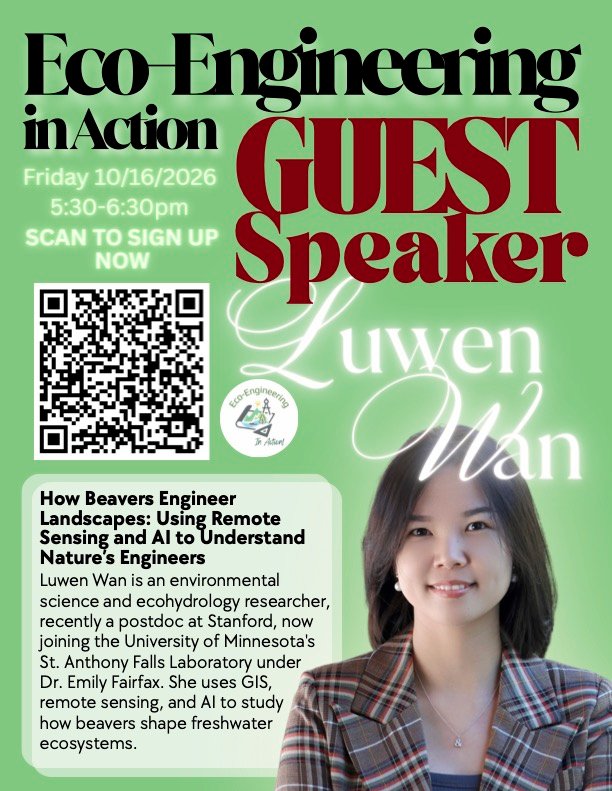
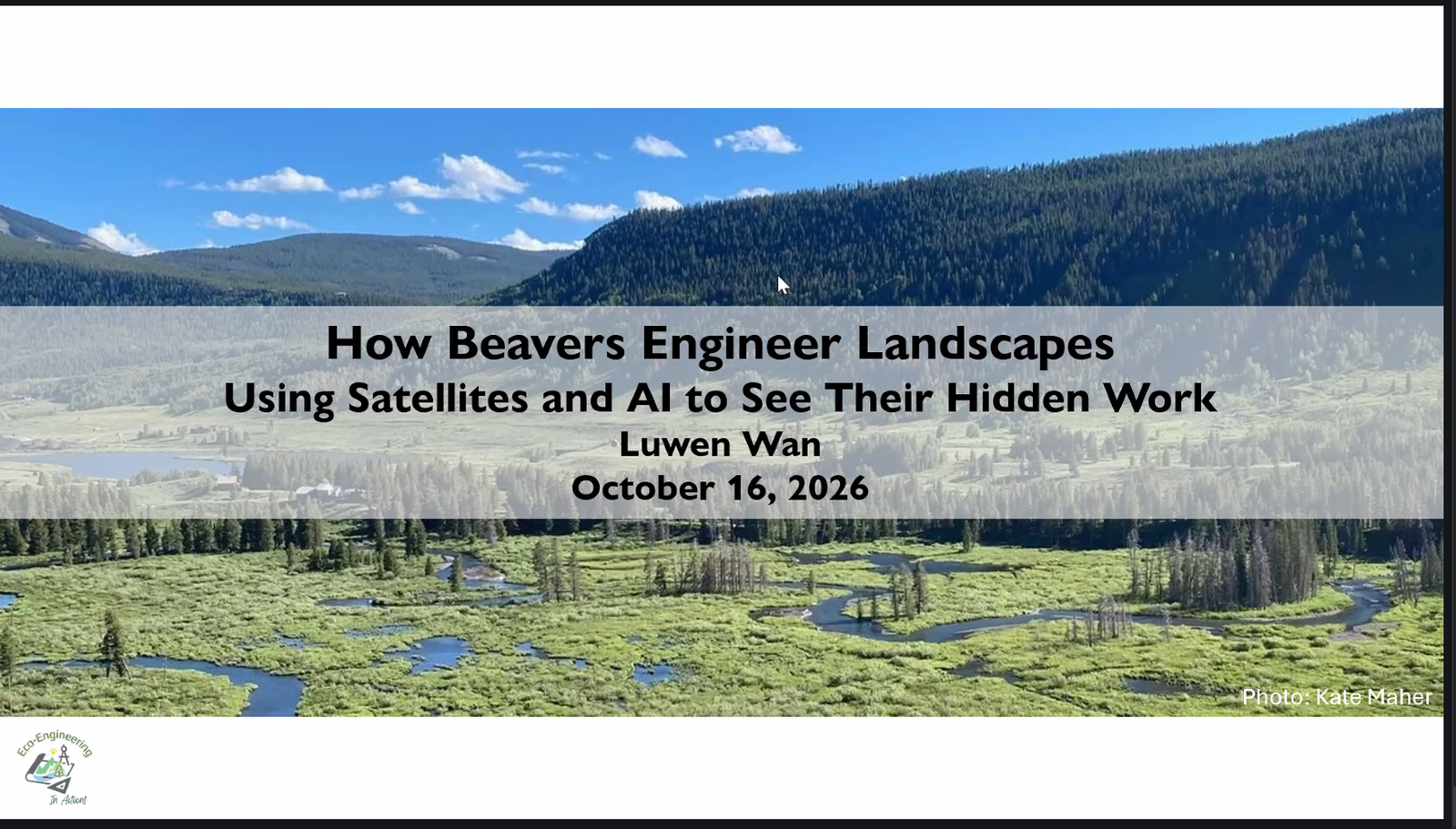
On October 16, Eco-Engineering in Action welcomed Dr. Luwen Wan, a former postdoctoral researcher at Stanford University who is now joining the University of Minnesota’s St. Anthony Falls Laboratory under Dr. Emily Fairfax, for a webinar exploring how artificial intelligence and remote sensing can help us better understand the ecological importance of beavers.
Beavers are secretly some of nature’s most influential ecosystem engineers. Through building beaver dams, they help hold water during dry periods, create habitat for wildlife, and help nearby plants stay green.
While individual beaver dams can be observed with the naked eye, more advanced techniques are required when studying thousands of ponds across large landscapes. Dr. Luwen Wan introduced her research using satellite imagery and Normalized Difference Water Index (NDWI) to identify water bodies and group beaver ponds into complexes. By comparing results with 45 manually outlined ponds, she found a strong agreement between the two, demonstrating the effectiveness and accuracy of remote sensing.
Building on this research, Dr. Luwen Wan is currently working on developing a pilot AI model to identify beaver ponds without known dam locations. An AI image encoder looks for patterns and estimates whether a pond will occur. Dr. Luwen Wan’s pilot AI model is still ongoing, holding exciting potential for the future of ecosystem restoration. During the Q&A, she discussed how her findings could eventually help researchers identify bodies of water that may require more observation.
For aspiring researchers, Dr. Luwen Wan shared an important piece of advice: be proactive. Reflecting on her own academic journey, she shared how little she knew about beavers before arriving at Stanford. Her ability to branch out led her to discover a new research interest. She emphasized that environmental science is an interdisciplinary field, encouraging students to seek out opportunities and build a foundation in the research methods related to their interests.
We thank Dr. Luwen Wan for sharing her research and experiences with us and look forward to hearing more about her future endeavors!